A doctor’s website should do more than display a name, photograph, qualifications, and phone number.
Think about a patient in Phoenix who has a health concern. They may not know which doctor they want to see yet. They may simply search Google for a specialist, treatment, or healthcare service.
They discover a few websites.
Now the question is: What happens when they visit yours?
Can they quickly understand your specialty? Can they find your services? Can they see where your practice is located? Can they learn about your professional background? Most importantly, can they easily understand what to do next?
This is where Digital Marketing for Doctor’s becomes more than simply getting a website to appear in search results.
A well-planned doctor website can become a central part of the patient’s online research journey.
Your Website Is More Than an Online Brochure
Many medical websites are designed like digital business cards.
They contain:
- Doctor’s name
- Specialty
- Qualifications
- Clinic address
- Phone number
- A few photographs
These details are important, but they may not answer all the questions a potential patient has.
A stronger website helps visitors move from search → information → confidence → contact.
For example, a Phoenix dermatologist could have dedicated information about acne care, hair loss, skin allergies, pigmentation, and other services actually offered by the practice.
A cardiologist could organize information around consultations, preventive heart care, cardiac evaluations, and other genuine services.
The exact structure should depend on the doctor’s specialty and services.
1. Build the Website Around Patient Search Intent
Before creating pages, think about what patients are actually trying to find.
A patient may search:
“Dermatologist in Phoenix”
Another may search:
“Doctor for persistent acne in Phoenix”
Someone else may search:
“Cardiologist near me”
These searches show different levels of intent.
Your website should provide information that matches those questions.
Instead of creating pages only for keywords, create pages that answer real patient needs.
This makes Digital Marketing for Doctor’s more useful because the website becomes an information resource rather than a collection of SEO phrases.

2. Create Dedicated Service Pages
One of the biggest opportunities for a doctor’s website is creating useful service pages.
Suppose a Phoenix orthopedic doctor offers several areas of care.
Instead of putting everything into one huge page, relevant services can have their own pages.
For example:
- Knee pain care
- Sports injury care
- Joint-related conditions
- Fracture treatment
- Orthopedic consultations
Each page can explain what the service involves, who may need an evaluation, what patients can expect from a consultation, and how to contact the practice.
The same concept can work for dermatology, cardiology, dentistry, gynecology, ENT, neurology, urology, and other specialties.
The information should always accurately represent what the doctor actually provides.
3. Make Phoenix Part of the Website Naturally
If a doctor serves Phoenix, the website should make that location clear.
But this doesn’t mean adding the word “Phoenix” to every sentence.
Instead, location can naturally appear in:
- Page titles
- Service pages
- Contact information
- About page
- Location page
- FAQs
- Helpful local content
- Doctor profile
- Google Business Profile information
For example:
Dermatology Services in Phoenix
is much more useful than repeatedly writing:
Best dermatologist in Phoenix, best dermatologist Phoenix, dermatologist Phoenix…
Natural language creates a better experience for both visitors and search engines.
4. Build a Clear Patient Path
Imagine a patient lands on your website after searching for a doctor.
What should happen next?
A simple path could look like:
Google Search → Website → Specialty → Service → Doctor Information → Contact
Every page should help the visitor understand the next relevant step.
For example, a service page could include a clear option to:
Call the Practice
Request an Appointment
or
Contact the Clinic
The exact call-to-action should match how the practice actually handles appointments.
This is one of the most important parts of Digital Marketing for Doctor’s because getting someone to a website is only one part of the process.
5. Turn Common Questions Into Website Content
Patients frequently have questions before contacting a doctor.
Instead of answering those questions only during consultations, practices can create educational website content around appropriate general topics.
For example, a Phoenix ENT practice could publish:
When Should You See an ENT Specialist?
A dermatologist could publish:
Common Reasons Patients Visit a Dermatologist
An orthopedic practice could create:
When Should Persistent Knee Pain Be Evaluated?
This type of content can attract people earlier in their research journey.
It also gives the doctor an opportunity to explain healthcare topics in a professional and easy-to-understand way.
The content should educate rather than diagnose individual readers or make guaranteed treatment claims.
6. Create a Strong Doctor Profile
A patient may find a service page first, but eventually they want to know about the doctor.
A useful profile can include:
- Full name
- Specialty
- Qualifications
- Professional experience
- Areas of expertise
- Services
- Clinic location
- Professional photograph
- Contact information
The profile should be easy to read.
Patients shouldn’t have to search through multiple pages to understand who provides the care.
MyDoctorTrust itself uses doctor profiles containing information such as specialization, experience, fees, location, and contact options as part of its doctor-discovery platform.
7. Connect Your Website With Google Business Profile
Your website should not operate separately from your local online presence.
Your Google Business Profile can help people discover important practice information through Google Search and Maps.
Make sure important details are consistent:
- Practice name
- Address
- Phone number
- Website
- Hours
- Services
If a patient finds one phone number on Google and another on your website, it creates unnecessary confusion.
Keeping information accurate is a simple but important part of Digital Marketing for Doctor’s.
8. Make the Website Useful on Mobile
A patient in Phoenix may search for a doctor from almost anywhere—at home, during a break, or while traveling around the city.
If the website is difficult to use on a smartphone, the visitor may leave.
Check whether patients can easily:
- Read the doctor’s information
- View services
- Find the address
- Tap the phone number
- Request an appointment
- Navigate between pages
Large readable text, simple navigation, fast-loading pages, and clearly visible contact options can make the website easier to use.
9. Use Local Content Instead of Generic Articles
A doctor doesn’t need hundreds of generic blog posts.
The better approach is to create useful content around the questions the practice actually receives.
For Phoenix practices, content can sometimes include relevant local context.
For example:
How to Choose a Dermatologist in Phoenix for Your Skin Concern
or
Questions to Ask Before Choosing an Orthopedic Doctor in Phoenix
The article should provide genuine information rather than simply repeating a location keyword.
This creates a content library that can support both patients and the broader SEO strategy.
10. Track What Patients Actually Do
A website can receive visitors without generating meaningful enquiries.
That’s why doctors should look beyond traffic numbers.
Useful website metrics can include:
- Phone clicks
- Appointment requests
- Contact-form submissions
- WhatsApp clicks where applicable
- Popular service pages
- Organic search traffic
- Engagement with educational content
For example, if a service page receives significant relevant traffic but very few contact actions, the practice can review the page structure, information, navigation, and calls-to-action.
This makes the website an evolving marketing asset instead of a page that is created once and forgotten.
11. Connect the Website With Your Wider Digital Presence
Your website should be the center of your digital ecosystem.
Other channels can support it.
For example:
Google → Website
Social Media → Website
Doctor Listing → Website
Blog → Service Page
Google Business Profile → Website
This creates multiple ways for potential patients to discover the same professional information.
MyDoctorTrust currently positions its doctor listings alongside broader digital visibility services such as SEO, Local SEO, Google Business Profile optimization, social media, content marketing, website optimization, and reputation management.
12. Give Every Important Page a Purpose
Before publishing a new page, ask one simple question:
What is this page helping the patient do?
Your homepage introduces the practice.
Your service pages explain what you provide.
Your doctor profile explains who provides the care.
Your blog answers general questions.
Your contact page makes communication easier.
Your location information helps patients find the clinic.
When each page has a clear purpose, the website becomes easier to navigate.
That’s the real value of Digital Marketing for Doctor’s—connecting different pieces of a doctor’s online presence into one useful patient experience.
A Simple Phoenix Example
Imagine a patient searches:
“Orthopedic doctor in Phoenix.”
They discover a doctor’s website.
The homepage clearly identifies the doctor as an orthopedic specialist.
The patient opens the orthopedic services section.
They find a dedicated page explaining the relevant service.
Next, they read the doctor’s qualifications and experience.
They check the clinic location.
Finally, they find a clear contact option.
The website has answered the patient’s basic questions without making the visitor search through the entire site.
That is what turns a doctor website into a patient-finding tool.
It doesn’t guarantee that every visitor becomes a patient. Instead, it creates a clearer path for people who are already researching healthcare options.
Common Website Mistakes Doctors Should Avoid
Doctors should avoid:
- Creating one page for every keyword with little useful information
- Copying articles from other websites
- Repeating “Phoenix” unnaturally
- Hiding contact information
- Using outdated clinic details
- Having incomplete doctor profiles
- Making unsupported medical claims
- Ignoring mobile users
- Publishing content without a clear purpose
- Measuring success only through website traffic
A professional healthcare website should prioritize accuracy, usability, clarity, and patient education.
How MyDoctorTrust Can Support Your Online Presence
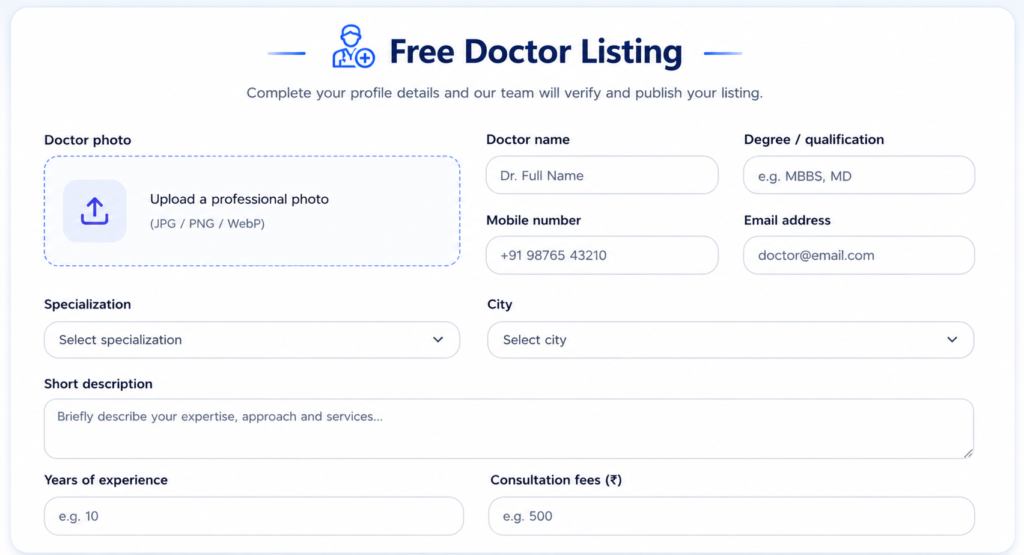
MyDoctorTrust is a healthcare discovery platform where patients can search for doctors by specialization, city, name, and other profile information. Doctors can create profiles that showcase their professional information and make it easier for patients to discover them.
For doctors building an online presence, a professional doctor profile can complement the practice website.
The website remains the place where detailed information about the practice and services can live, while a doctor listing provides another discovery point.
Together with SEO, Local SEO, Google Business Profile optimization, content, social media, and reputation management, these channels can form a broader online visibility strategy.
Frequently Asked Questions
How can a doctor’s website attract more patients in Phoenix?
A doctor’s website can become more useful for patient discovery by clearly explaining the doctor’s specialty, services, location, qualifications, and contact options. SEO, local content, service pages, and a mobile-friendly design can support this process.
What should a Phoenix doctor’s website include?
A medical website can include the doctor’s qualifications, specialty, experience, services, clinic location, contact information, appointment options, FAQs, and educational content.
Are service pages important for doctor websites?
Yes. Dedicated service pages can provide detailed information about individual services and help visitors find answers related to their specific needs.
Is Local SEO part of digital marketing for doctors?
Yes. Local SEO can support a doctor’s visibility for searches related to their specialty and geographic service area.
Should every doctor have a Google Business Profile?
Maintaining an accurate Google Business Profile can help eligible practices present important business information through Google Search and Maps.
Can a doctor blog help attract website visitors?
Yes. Useful, patient-focused articles can answer common questions and provide additional entry points to the website. Content should be accurate, responsible, and written for patients rather than only for search engines.
How can MyDoctorTrust help doctors online?
MyDoctorTrust provides doctor profiles and doctor-discovery functionality, along with digital marketing services such as SEO, Local SEO, Google Business Profile optimization, content marketing, social media marketing, website optimization, and online visibility support.
How long does it take to build an effective doctor website strategy?
There is no fixed timeline. Results depend on factors such as the website’s existing condition, competition, content quality, local visibility, technical SEO, and how consistently improvements are made.
Final Thoughts
Your website should not simply tell patients that your practice exists.
It should help them understand who you are, what you provide, where you are located, and how they can take the next appropriate step.
For a Phoenix doctor, that means building a website around real patient questions rather than simply filling pages with keywords.
A strong homepage, useful service pages, a clear doctor profile, local information, educational content, mobile usability, and simple contact paths can work together to turn your website into a genuine patient-finding tool.
That is where Digital Marketing for Doctor’s becomes valuable—not as a collection of disconnected marketing activities, but as a structured online experience that helps potential patients discover and understand your practice.