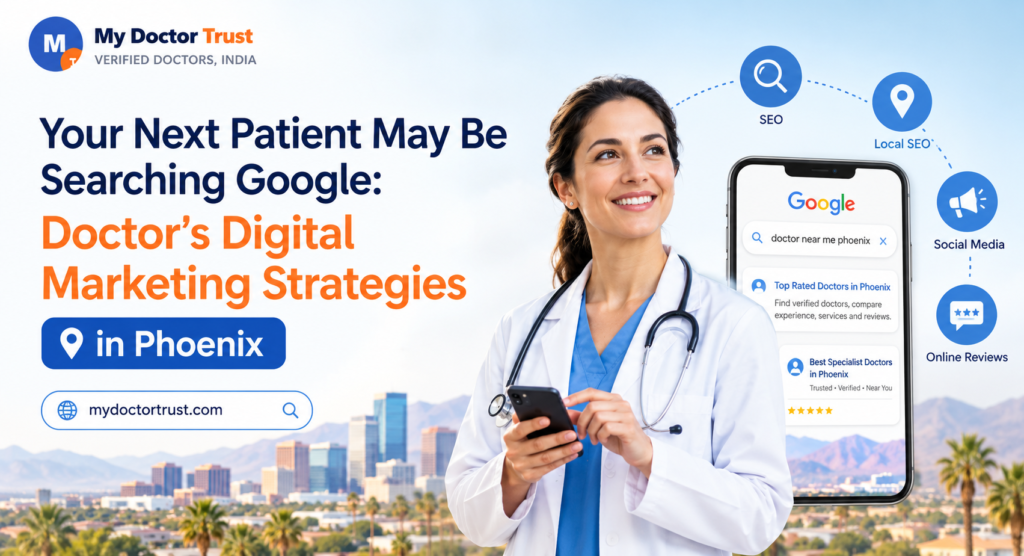
Imagine a patient in Phoenix who suddenly needs to find a dermatologist, cardiologist, orthopedic doctor, dentist, or another specialist.
They open Google and type something simple:
“Dermatologist near me.”
“Cardiologist in Phoenix.”
“Best orthopedic doctor near me.”
“Dentist in Phoenix.”
Within seconds, that patient may see websites, Google Business Profiles, doctor directories, social media pages, reviews, and educational content.
The doctor they eventually contact may not be the first doctor they have heard about. It may simply be the practice that made the information easiest to understand and the next step easiest to take.
This is where Doctor’s Digital Marketing Strategies become important.
For Phoenix doctors, digital marketing is not just about advertising a medical practice. It is about building a useful online presence that helps potential patients discover the practice, understand its services, learn about the doctor, and contact the office.
Why Phoenix Doctors Need a Patient-Focused Online Strategy
A medical practice can have excellent doctors and years of experience, but that information has limited value online if patients cannot find it.
A potential patient may want to know:
- What does the doctor specialize in?
- Where is the clinic located?
- What treatments or services are offered?
- What qualifications does the doctor have?
- How can I contact the practice?
- Is the website easy to use?
- Are there genuine patient reviews?
- Can I find useful information about my concern?
A good digital strategy brings these pieces together.
The purpose of Doctor’s Digital Marketing Strategies should therefore go beyond increasing website traffic. The bigger objective is to create a clear path from online discovery to meaningful patient enquiry.
Register for Free Doctor Listing
1. Start With the Patient’s Search Journey
Before choosing marketing channels, think about how a Phoenix patient actually searches.
Someone may start with a broad search such as:
“Doctor near me.”
Another person may already know what they need:
“Phoenix dermatologist.”
Someone with a specific concern might search:
“Skin specialist for acne in Phoenix.”
These searches represent different stages of the patient journey.
A doctor should understand the questions patients are asking and create online information that answers those questions.
This can influence website pages, blog topics, Google Business Profile information, social media content, and doctor profiles.
Instead of creating content simply because a keyword has search volume, create content because it answers a genuine question from a potential patient.
2. Build a Website That Answers Important Questions
Your website should make it easy for a visitor to understand the practice.
A Phoenix doctor’s website can clearly present:
- Doctor name
- Specialty
- Qualifications
- Professional experience
- Services
- Clinic location
- Office hours
- Contact information
- Appointment options
- Frequently asked questions
- Educational resources
The website should also be easy to navigate on smartphones.
A patient searching from a mobile device should not have to search through several pages just to find a phone number or clinic address.
Good Doctor’s Digital Marketing Strategies begin with a website that works as an information resource, not simply as an online brochure.
3. Create Pages Around Real Services
One common mistake is putting every service on one general page.
Suppose a Phoenix dermatologist offers acne care, hair-loss services, pigmentation treatment, and skin allergy care.
Instead of discussing everything briefly on one page, useful individual service pages can explain each area in more detail.
The same approach can work for other specialties.
For example:
Orthopedic practice
- Knee pain
- Joint care
- Sports injuries
- Fracture care
Cardiology practice
- Heart checkups
- Preventive cardiology
- Blood pressure management
- Heart-related evaluations
The exact services should always reflect what the doctor actually provides.
This structure helps patients find information that is directly relevant to their needs.
4. Make Local Visibility Part of the Strategy
Phoenix doctors generally serve a defined geographic area.
That means online visibility should reflect the location where the practice actually operates.
Relevant phrases may include:
- Doctor in Phoenix
- Cardiologist in Phoenix
- Dermatologist in Phoenix
- Orthopedic doctor in Phoenix
- Dentist in Phoenix
You can also create useful content related to nearby communities when it genuinely helps patients.
The goal is not to insert “Phoenix” into every sentence.
The goal is to clearly communicate the practice’s location while providing useful information.
This is where SEO and Local SEO can work together.
5. Turn Medical Questions Into Useful Content
Patients have questions before they make appointments.
A dermatologist may hear:
“Why is my skin becoming unusually dry?”
An orthopedic doctor may hear:
“When should knee pain be evaluated?”
A cardiologist may hear:
“What should I know before a heart checkup?”
These questions can become blog posts, FAQs, short videos, social media posts, or website resources.
The content should be educational and easy to understand.
It should not promise a specific medical outcome or attempt to diagnose an individual reader.
For Phoenix practices, locally relevant examples can make educational content feel more connected to the people the practice serves.
6. Strengthen the Doctor’s Professional Profile
Patients often want to know more about the person behind the practice.
A professional doctor profile can include:
- Full name
- Medical qualifications
- Specialty
- Experience
- Areas of expertise
- Services
- Clinic location
- Professional photograph
- Contact information
Doctor directories can also provide another place where patients discover this information.
MyDoctorTrust’s platform is built around helping patients discover doctors by information such as specialization, name, and location, while giving doctors opportunities to create professional profiles.
For a Phoenix doctor developing an online presence, a profile can complement the practice website rather than replace it.
7. Use Google Business Profile as a Local Touchpoint
A doctor may have a strong website but still need accurate local business information.
Google Business Profile can help patients find important practice details through Google Search and Maps.
Information should be kept accurate, including:
- Practice name
- Address
- Phone number
- Website
- Hours
- Services
- Photos
If the practice changes its phone number or location, the information should be updated across relevant online profiles.
This creates a smoother experience for someone who is ready to contact the office.
8. Build Content That Supports Trust
Healthcare decisions require more consideration than many everyday purchases.
That means content should feel professional and transparent.
Instead of writing:
“Choose us for guaranteed results.”
A better approach is to explain:
- The doctor’s qualifications
- The services offered
- What patients can expect
- Common questions
- General educational information
- How to contact the practice
This is an important distinction in Doctor’s Digital Marketing Strategies.
Marketing should communicate what the practice genuinely offers rather than make promises that cannot be supported.
9. Use Social Media With a Clear Purpose
Social media can be useful when it supports the doctor’s broader online presence.
A Phoenix doctor might share:
- Short educational videos
- Common patient questions
- Health awareness information
- Doctor introductions
- Clinic updates
- General wellness information
- Links to useful website articles
For example, a dermatologist could create educational content about common skin concerns.
A cardiologist could explain general heart-health topics.
An orthopedic doctor could discuss common causes of joint discomfort.
The purpose is not to turn every post into an advertisement.
Useful content can help patients become more familiar with the doctor’s professional expertise.
10. Make Reviews Part of Your Reputation Strategy
Online reviews are another part of the digital patient journey.
Patients may compare several practices and look at feedback before contacting a doctor.
Doctors should focus on genuine patient experiences and follow the rules of the platforms where reviews are collected.
Avoid buying, fabricating, or manipulating reviews.
A strong online reputation should reflect the actual patient experience.
It is also useful to respond professionally when appropriate.
A review strategy should support reputation—not replace the quality of the underlying patient experience.
11. Connect Every Digital Channel
One of the biggest opportunities is connecting different parts of the online presence.
Think about this journey:
Google Search → Website → Doctor Profile → Services → Reviews → Contact → Appointment
Now imagine the same patient finding the doctor through social media or a doctor directory.
The destination may be different, but the information should remain consistent.
The doctor’s name, specialty, services, location, phone number, website, and other important details should not conflict across platforms.
This creates a more professional and understandable digital experience.
12. Measure More Than Website Traffic
Getting more visitors is useful, but traffic alone does not tell the whole story.
Doctors can look at meaningful indicators such as:
- Website enquiries
- Calls
- Appointment requests
- Contact-form submissions
- WhatsApp enquiries where applicable
- Google Business Profile interactions
- Organic search visibility
- Engagement with educational content
The important question is:
Are the right people finding useful information and taking the next appropriate step?
That question can help a practice improve its marketing strategy over time.
How MyDoctorTrust Fits Into a Doctor’s Digital Strategy
Register for Free Doctor Listing
MyDoctorTrust combines doctor discovery with opportunities for doctors to build an online presence.
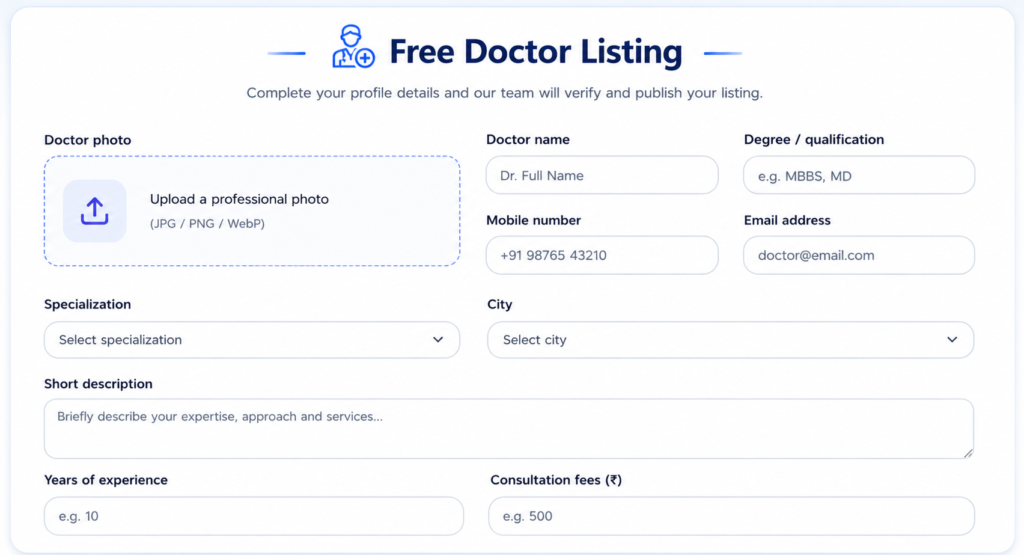
Doctors can create professional profiles containing information such as specialization, experience, services, location, and contact details.
The platform’s broader digital marketing approach includes SEO, Local SEO, Google Business Profile optimization, social media marketing, content marketing, website optimization, and online visibility.
For doctors serving Phoenix, an online doctor profile can become one additional touchpoint within a wider strategy.
The important thing is that every profile should contain accurate, professional, and useful information.
A Simple Example
Imagine a Phoenix patient looking for a dermatologist.
The patient searches Google and finds several options.
One website has very little information.
Another has a clear doctor profile, service pages, educational articles, location details, reviews, and an easy way to contact the practice.
The patient can quickly understand what the doctor does and where the practice is located.
That does not guarantee that the patient will choose that doctor.
However, it gives the patient useful information for making their own decision.
That is the real purpose of effective Doctor’s Digital Marketing Strategies.
Common Mistakes to Avoid
Phoenix doctors should avoid:
- Keyword stuffing
- Copying articles from other websites
- Publishing unsupported medical claims
- Buying fake reviews
- Using outdated contact information
- Creating incomplete doctor profiles
- Ignoring mobile users
- Focusing only on rankings
- Publishing content without a clear patient purpose
- Expecting immediate SEO results
Digital marketing is an ongoing process.
A professional online presence usually develops through consistent improvements rather than one single campaign.
Frequently Asked Questions
What are Doctor’s Digital Marketing Strategies?
Doctor’s Digital Marketing Strategies are methods used to improve a doctor’s online presence and help potential patients discover useful information about the doctor, services, location, and practice. They can include SEO, Local SEO, content marketing, social media, Google Business Profile optimization, website optimization, and reputation management.
How can Phoenix doctors improve their online visibility?
Doctors can improve online visibility by maintaining an informative website, optimizing relevant local information, creating useful healthcare content, maintaining an accurate Google Business Profile, building professional profiles, and keeping their online information consistent.
Is SEO important for doctors in Phoenix?
SEO can help a medical practice become more discoverable when people search for relevant healthcare services. The strategy should focus on relevant services and the actual geographic area the practice serves rather than simply repeating keywords.
Should doctors create separate service pages?
Separate service pages can be useful when a practice offers multiple services. Each page can explain one service clearly and answer questions that potential patients may have.
Can social media help a doctor’s practice?
Professional and educational social media content can help doctors communicate health information, introduce their practice, answer common questions, and maintain another digital touchpoint with potential patients.
How can MyDoctorTrust help doctors?
MyDoctorTrust provides doctor profile and listing opportunities and supports digital marketing activities such as SEO, Local SEO, Google Business Profile optimization, social media marketing, content marketing, website optimization, and online visibility.
How long does doctor digital marketing take to show results?
There is no universal timeline. Results can vary based on competition, website quality, existing online presence, content quality, location, services, and how consistently the strategy is implemented.
Final Thoughts
Your next patient may already be searching Google.
The question is whether your online presence gives that person enough clear, useful, and professional information to understand your practice.
For Phoenix doctors, effective Doctor’s Digital Marketing Strategies should connect several pieces: a helpful website, relevant service pages, local visibility, educational content, professional doctor profiles, genuine reviews, social media, and accurate business information.
Instead of treating digital marketing as one advertising activity, think of it as the complete online experience a patient has before contacting your practice.
When that experience is clear, informative, and consistent, your practice has a stronger foundation for being discovered by people searching for healthcare in Phoenix.